
I, like many people in this country, have been thinking about Kendrick Lamar’s halftime performance for the past few days. There is an unbelievable amount of writing/videos/posts about this by now, but yesterday on the socials, I was still seeing lots of White folks commenting about being confused, not liking it, feeling like they missed something. So, I thought since I have been ingesting SO MUCH of the discussion, I would lend a hand and help out.
Now, you may be thinking, isn’t this blog about grief and healing and doing things for the first time to create joy and new memories. And yes, it is. But hear me out here. The reason I loved my Dad, and my Mother-in-Law, and even my Mémère Doris (who passed in 2013) so much is because I spent so much time with them, and I talked to them, and got to know them as much as they would let me. And one thing I cherished about all three of them is that they would listen to me, hear my ideas, even when they were new, foreign, or disagreeable to them, and ask me questions, or get curious. My Dad used to shake his head after I’d jump in with some new fact and say, “See, she knows everything.” And Mémère would always laugh after one of my info dumps and say, “You’re so smart!”
I would never claim to be a genius, or know everything. But I love learning, I love music, and I love culture. And my dearly departed beloveds gave me a gift. They let me know that my love of learning was a special part of me. One that they enjoyed and cherished. And they let me be me and say what I wanted to say, and know that it was valued. And so, because I can’t help myself….here you go.
First to understand why this halftime show was a big deal and controversial, you have to understand the feud between Kendrick/Drake (that’s another rapper). I cannot explain all of that here, but if you enjoy comedy, and you have 27 minutes, Josh Johnson can explain it to you in a funny way.
All I have to say about this is this beef was fought through music that was released through most of last year, culminating in Kendrick’s “Not Like Us” which was a huge radio hit and just won 5 Grammys. So, by those standards he was the winner. But the big question was, was he going to sing it on the country’s largest stage, at the SuperBowl, even when Drake has filed petitions against the music company that released the song for defamation. (Sensational, right?)
Spoiler, he did.
So, Kendrick is known for his hidden messages and symbolism, and his blending of the personal and political. And since he knew everyone would be watching, he took this opportunity to not only bring his diss track to the next level, but also say a few other things he wanted to say to the American people while he had our eyeballs.
And I know that if you haven’t heard these songs before that you didn’t understand the lyrics and that is OK. I’m just going to talk about them in general, because the lyrics would need a whole other interpretation class. But I’ll put it like this: you probably did not understand Shakespeare the first time you read it. I know I didn’t.

And heck, none of us ever really knew what Eddie Vedder was singing, but we enjoyed the ride. This is worth taking the time to absorb. It might not make sense immediately, but this is not beyond your reach!
Here is my little tour de imagery from the show. This isn’t everything. But it’s the things that stood out to me the most. And I’m sure I could go back again and again and find more. But let’s start here.

Uncle Sam: I knew this would be special when I saw Samuel L. Jackson kick things off dressed as Black Uncle Sam. Samuel L. has famously portrayed “Uncle Tom” characters (that is from the book Uncle Tom’s Cabin, and in pop culture is a derogatory term for a Black person–usually a man–who is subservient to white people or follows white cultural norms, especially when that is detrimental to the well-being of themselves or other Black people). Anyways, he says a number of things through the performance, welcoming us to “the Great American Game,” telling Kendrick he is being “too ghetto,” and finally accusing him of using a cultural cheat code by bringing his friends along and for the “Scorekeeper” to “deduct one life.”
There were a few things I saw here that were interesting. First, Uncle Sam was a stand-in for the voice of “America” specifically White America. He was tone-policing Kendrick, reminding him that if he brought his whole Black, Compton-raised, rapping self to this stage, the part of America whose judgement matters in the great American Game (not the football game, but the game of survival, fame, and respectability politics), wouldn’t like it.
He was also functioning as a hip-hop skit, which is a tradition on rap and hip-hop albums where there is a sketch between songs throughout the album, tying the music together with a story. His presence and running commentary let us know that this wasn’t just a greatest hits medley (which it really wasn’t) but this performance was telling a story, and these songs, and the order they are played in, do have a meaning.

Red, White and Blue: The dancers wore red, white, and blue suits – those were the only colors in the performance. So, I know this is obviously the colors of America, and the flag. (EDIT) and please take a look at the comment below for some more commentary from my cousin Jessie.
But one thing Kendrick did promise in this show was to bring some of his L.A. flavor to the stage. And blue and red are the colors of the Crips and Bloods, the major gang families of L.A. The dancers take the stage in the formation of an American flag, embracing each other, then they quickly divide, doing a perfectly synchronized dance where they get in a fighting stance, then hold their punches.
There have been historic moments where the Crips and Bloods called a truce or united. Famously in 1992, the gangs signed a peace agreement. And more recently under Kendricks’ influence, coming together to make heart symbols w/their hands on the cover of Kendrick’s “i” single, and to attend and celebrate The Pop Out, a concert he held in L.A. last year. And so, Kendrick was reminding us that there are reasons to come together with those we think are different, and that peace is possible. It doesn’t mean we have to lose who we are.
The white in this context can be a lot of things – white people, bystanders, angels who have died from violence, those yet to be born into the current situation, essentially everyone else.
One more word about the flag – I saw lots of posts calling out the performance for lack of diversity and being “racist.” Now, let’s stop that right there and take a breath. This was incredibly intentional, and meant to provoke you and remind you (referencing that comment below again) that America as we know it would not exist without Black people. To deny that or revise that or imagine something different erases the experiences of millions of people and everything Black people had to overcome to be able to live, and succeed wildly, as Kendrick has.
The two sides of the flag can choose to come together, bringing everyone tangled in the fight along for the ride, or we can stay apart, and let the violence come to the obvious conclusion. And all of this drama was backed by his song “Humble” in which he brags about how awesome he is coming from nothing and then rising to one of the biggest names in rap, but he remembers that it was his experience and roots that got him here. So, he turns inward and reminds himself to “be humble, sit down.” This was clear – fighting will not make us bigger, special or more important. We cannot have peace if we cannot be humble. And even though Kendrick made it here, he’s still going to be himself.
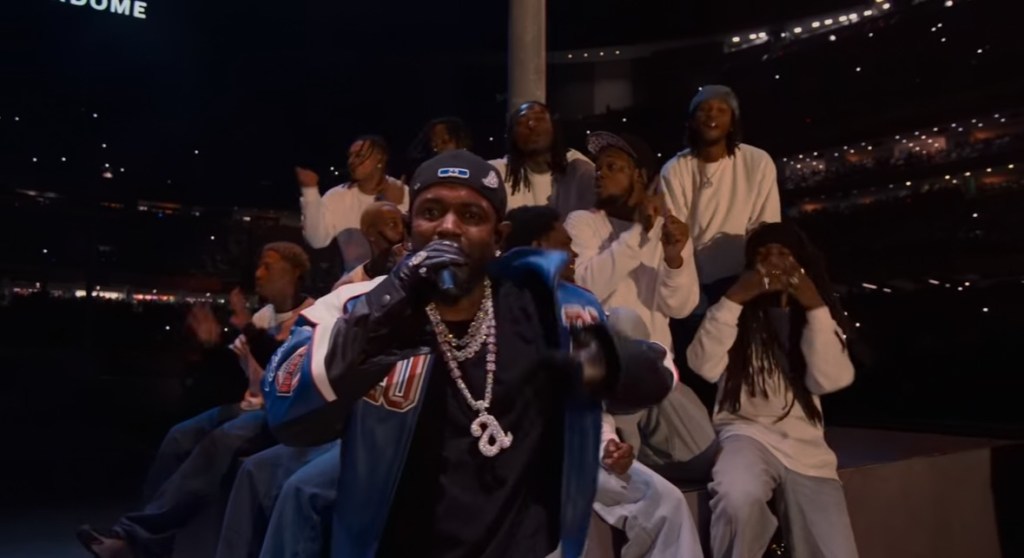
The set: The set was both a video game console (same as the Playstation buttons) and an L.A. street. I heard some people say it also resembled a prison yard. When I saw the street motif I immediately thought of the protest chant, “Whose streets? Our streets!” And watching the streets be filled with dancing, exuberant Black bodies was a clear statement of power.
We see a man lounging/hanging on a lamp post, and then Kendrick launches into Man at the Garden, backed up by a chorus of men under the streetlamp. It reflected images I know I have seen in movies and music videos of men singing doo wop under streetlamps, something often thought of as romantic, but Uncle Sam quickly comes in and chides Kendrick, “Ah, see you brought your homeboys with you, the old culture cheat code. Scorekeeper, deduct one life.”
All I could think of here was the fear that (white) America proclaims at DEI, Black Lives Matter, and public protests. Inevitably, when Black bodies congregate on the streets, violence against their bodies occurs, usually at the hands of (white) police. And we hear another tragic story of a person losing their life, or being arrested. Both ways that Black lives are “deducted” from society systematically.
So Kendrick switches sets and plays “peekaboo” his next song, jumping in and out of the camera in front of a solid background of dancers in white, staying alive by bobbing and weaving in and out of view.
FINALLY we get a massive hit with SZA, and then our diss track, the one we’ve all been waiting for, and Kendrick’s smile throughout this performance is high wattage. As he sings, the dancing and choreography reach their climax, with dancers in all three colors running and jumping the length of the field, at one point scattering like chalk outlines on the ground, a mass of bodies seen from an overhead drone shot. He’s asking us where this is all going, and what are we getting out of celebrating this song.
He starts out by telling us “it’s a cultural divide, I’ma get it on the floor. Forty acres and a mule, this is bigger than the music.” He knows that there are two primary ways America is going to view this performance, but he needs to share it anyway. And if there was any mistake, he’s reminding us exactly where he is coming from. Forty acres and a mule is reference to a Civil War order to confiscate land from the Confederacy and distribute it, in 40 acre parcels, to some previously enslaved families. The mules were to be lent from the army for farming efforts. This was to be reparations to Black families for the horrors and injustice they endured in slavery, and an opportunity for them to build wealth and ownership. This order was reversed or rewritten by Andrew Jackson, whose policies focused more on wage earning over land ownership for freemen, and returned most of that confiscated land to the original white owners.
Kendrick is reminding us the facts of what happened are clear. A promise was made and it was broken. But, he also knows that Americans interpret this history in two ways. Whose land should that be? It’s a cultural divide.

Television: He kicked off the performance with the line “The revolution ‘bout to be televised. You picked the right time, but you picked the wrong guy.”
This was a direct reference to the 1971 poem/song “The Revolution Will Not Be Televised” by Gil Scott-Heron (that has been covered and interpreted by many artists since). In his own words, Scott-Heron said that song was about the fact that you could not change things by looking outside yourself, you had to look within and figure out how to connect with your community. The song also makes clear that if Black culture is systematically left out of popular culture, and if the point of pop culture is to promote capitalism, then anything promoted there will be against our interests, and is actually keeping us from getting off our couches and organizing together.
Kendrick, being invited to take 13.5 minutes of America’s time to share his viewpoint, was probably unthinkable to Scott-Heron when he wrote the poem. And so Kendrick is taking a moment to honor that, and letting us know he is not going to play the American Game. He is going to bring his whole self to this performance, and ask us to join him.
He ends the show with “TV off” which also has the lyric “This revolution been televised, I fell through with the knick-knacks”.
His final words to us: “They actin bad, but somebody gotta do it; Got my foot up on the gas, but somebody gotta do it; Turn his TV off, turn his TV off.” He is telling us, like Scott-Heron did, that while he has a message for us, his performance is not the end. You have to turn the TV off, remember who you are and what you believe in, and then go connect with your people. It was a bold way to cap off an appearance on the biggest TV event in the country.
Conclusion: You might dismiss this whole thing as not “for you” but I think it is. It’s for all of us. The language may not have come so easily for you, but the joy is in the learning, the interpretation, the achievement of understanding and eventually fluency.
There are so many languages in our America today: Black, White, Conservative, Progressive, Professional, Casual. We may use the same words but they mean different things. There are languages we choose to speak in secret, and those we show the world. There’s a term called code-switching. White America has asked Black America to do this for centuries, as it means switching between languages/norms. Be one person at work, and another with your friends.
And there is an entire culture that has developed outside of our White experience. And that, I understand, feels hard for us White folks. Being excluded is never easy to accept. But this performance was an INVITATION: to listen, learn, research, understand and participate. To not be sitting on the sidelines like the audience, or on your couch, like the viewers. To actually “turn the TV off” and have a conversation.
Yesterday I read an article that noted that multilingual children with autism actually score higher in many executive functions than their monolingual counterparts. The theory is that having to switch between two languages is great practice for managing distractions, improving memory, and managing transitions. It’s also been shown in previous studies to improve empathy.
So, if you are just learning the language of rap and hip-hop, I invite you to keep at it. It will actually bring you more benefits than you know. And if nothing else, I hope this opened your eyes to how beautiful and complex and intellectual rap can be. I had a blast researching this, and writing about it, and thank you for coming along.
Want to know where I learned all this stuff?
Here’s a few of my sources:
Dissect podcast (this podcast has dissected the songs and lyrics of several hip hop albums, including Kendrick Lamar’s): https://dissectpodcast.com/
Watts Truce: https://en.wikipedia.org/wiki/Watts_truce
Crips- Bloods gang war: https://en.wikipedia.org/wiki/Crips-Bloods_gang_war
Multilingualism improves crucial cognitive functions in autistic children” https://newsroom.ucla.edu/stories/multilingualism-improves-crucial-cognitive-functions-in-autistic-children
Gil Scott-Heron interview clip: https://www.youtube.com/shorts/AQrlfbHK8Qo
The Revolution Will Not Be Televised full song: https://youtu.be/QnJFhuOWgXg?si=sbsAVdZPRcLDGUnm
40 acres and a mule: https://en.wikipedia.org/wiki/Forty_acres_and_a_mule
These creators on Threads had some great write ups, videos, and reposts:
https://www.threads.net/@dionnachambers


 A Year of Firsts
Leave a reply to Jessica Moore Wilson Cancel reply